What is an Exhibitor Appointed Contractor?
An exhibitor appointed contractor, or EAC, is any contractor you hire directly to work on your booth instead of the show’s general service contractor. Here is what one can and cannot do for you, what the show needs before they are allowed on the floor, and how far you can get with your own staff.
The short answer
A crew you choose, instead of the crew the show assigns you
Every show appoints one general service contractor: GES, Freeman or similar. Ordering labor from them is the default. Hiring your own installation crew makes that crew an EAC, and the show has a process for it.
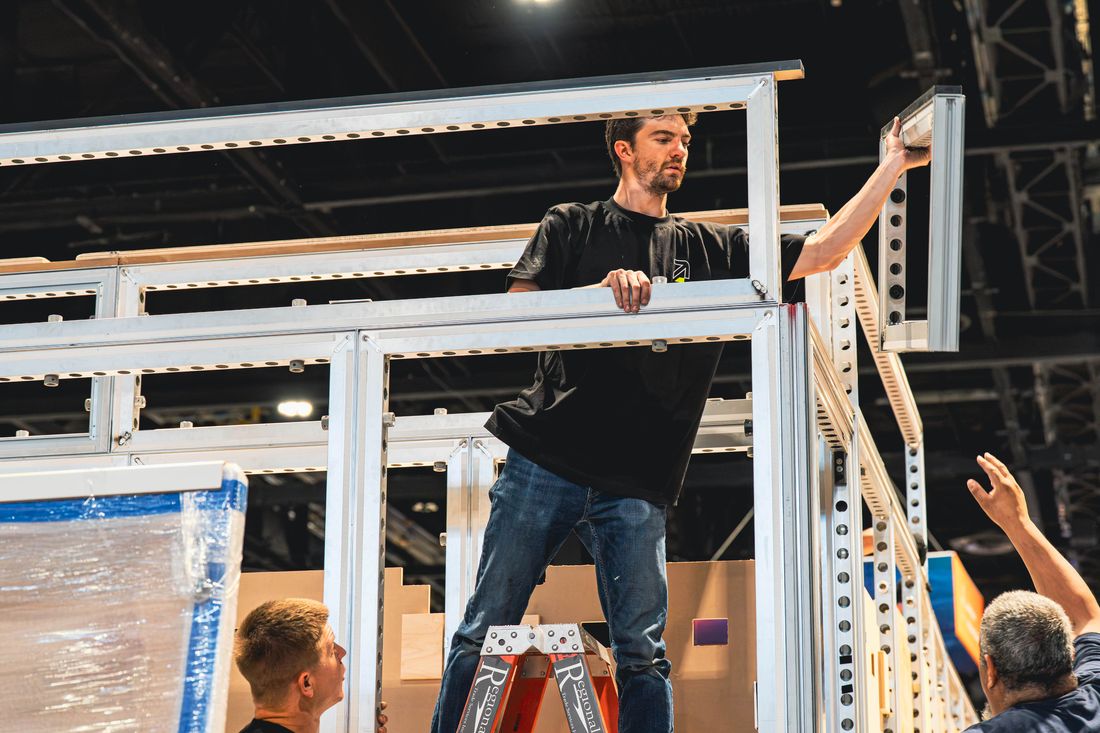
An exhibitor appointed contractor (EAC) is any company an exhibitor hires directly to perform work on its exhibit that the show’s general service contractor would otherwise perform. Trade show installation and dismantle labor is the most common example. Audio-visual technicians, florists, photographers and display supervisors are EACs too.
The exhibitor contracts with the EAC and pays them directly. The show does not choose them, does not price the work and does not manage them. It does, however, have to approve them, because the EAC’s crew will be working inside a building the show is responsible for, alongside union labor the general service contractor is responsible for.
That approval is a paperwork process, not a negotiation. Meet the requirements by the deadline and you are in. Miss the deadline and your crew can be turned away at the door, which is the single most expensive mistake in this process.
The division of labor
What you can hire out, and what stays with the show
This is the part exhibitors are most often surprised by. Hiring an EAC does not replace the general service contractor. Certain services remain exclusive to them at every show, no matter who else you bring in.
An EAC can do this
What you may hire your own crew for
- Install and dismantle your exhibit
- Set and level flooring, build walls, hang graphics and assemble structure
- Install your own hanging sign once it has been flown into position
- Supervise a build and manage your on-site schedule
- Dismantle, pack and prepare your exhibit for outbound shipping
- Audio-visual, floral, photography and other specialty services
Only the general service contractor can
Exclusive, at essentially every show
- Material handling and drayage. Moving your freight between the dock and your booth space
- Dock access. The loading docks are under their control for the duration of the show
- Rigging. Anything suspended from the ceiling, including flying your hanging sign
- Utilities. Electrical, plumbing and compressed air
- Powered equipment. Forklifts, scissor lifts and anything motorized on the floor
The hanging sign trap. At many venues the rigging crew flies the sign and nothing more. Assembling it is somebody else’s job. At the Orange County Convention Center, for example, all rigging is performed by the facility, while the exhibitor or its contractor assembles the sign itself. Budget labor for both halves, or your sign sits in a crate.
Getting approved
Four things every show asks for
The specifics differ show to show, but the shape of the requirement does not. All four are handled before you arrive, and all four have deadlines.
Notice of intent to use an EAC
A form you submit to show management naming the contractor you intend to use. Deadlines commonly land about a month before move-in. Coverings 2026, for instance, set 16 February for a show opening in late March. Treat the exhibitor manual’s date as hard.
Certificate of insurance
Carried by the contractor, not by you. The common ask is $1,000,000 per occurrence and $2,000,000 aggregate in general liability, plus workers’ compensation as required by law with employer’s liability around $1,000,000.
The right parties named as additional insured
This is where certificates get rejected. The list usually runs to the show itself, the organizer, the general service contractor and the facility, each with its officers, directors, agents and employees. Send the manual’s exact wording to your contractor’s broker.
Badges for every worker
EAC crews are badged or wristbanded through show management, not waved in on the exhibitor’s badges. Headcount goes in with the paperwork, so tell your contractor the crew size early.
A working EAC files its own paperwork. Ask any contractor you are considering whether they will submit the notice and certificate on your behalf and confirm acceptance with show management. If the answer is that you should handle it, you have found out something useful about how the rest of the job will go.
Before you hire anyone
Can your own staff just set up the booth?
Sometimes, and the answer depends far more on the city than on the size of your booth. Where you can do the work yourself, the people doing it must be full-time employees of the exhibiting company and carry identification proving it, and that rule is close to universal.
| Where | What your own employees may typically do | Watch for |
|---|---|---|
| New YorkJavits Center | Install and dismantle your own exhibit and lay your own carpet, provided the booth is 250 sq ft or less and no tools are used. Hand-carry materials, or use nothing larger than a two-wheel baggage cart with rubber or plastic wheels. | Carpenters hold jurisdiction over booth erection and dismantle. Teamsters handle all freight in the hall. |
| Southern CaliforniaLACC, Anaheim, Moscone | Work one person can complete in under half an hour without tools. Carry in only what one person can manage in a single trip, with no dollies or hand trucks. | Unusually, your staff may work one-to-one alongside a union installer. Go past the half hour and the work moves to contractor-supplied union labor. |
| BostonMenino (formerly BCEC), Hynes | Set up and dismantle your own booth using your own company employees. Two-wheeled hand trucks and flat trucks you provide are permitted for your own material. | A display house may send supervision only, and its workers cannot physically erect the booth unless they are local union members. This is the one that catches out-of-state exhibit houses. |
| OrlandoOrange County Convention Center | Florida is a right-to-work state. Your full-time employees may set up the display using tools, place merchandise, set signs and graphics, and plug in equipment once power is at the booth. | The general service contractor still owns all material handling and the docks, and all rigging is done by the facility, but you assemble the hanging sign. |
| TexasKBH Dallas, GRB Houston, Henry B. Gonzalez | Right-to-work. Badged full-time employees of the exhibiting company may perform install and dismantle on their own exhibit. | Material handling and powered equipment still belong to the general service contractor. |
Check your exhibitor manual before you rely on any of this. Work rules are set per show by the general service contractor and show management, not by the building alone, and they change. The table above is the pattern you should expect in each market. The binding version is the one in the manual for your specific show. If you would rather not read it, send it to us and we will tell you what applies to your booth.
Why exhibitors hire their own crew
The same hands on your booth, show after show
Ordering labor from the general service contractor gets you whoever is available that morning. They have not seen your exhibit before and they will not see it again. For a simple inline booth that is usually fine. For anything with custom structure, it is the reason install runs long.
- A crew that already knows how your exhibit goes together
- A quoted price before the show, not an invoice after it
- One point of contact across every city on your calendar
- Someone accountable for the dismantle, when most damage happens
- Paperwork filed on your behalf, ahead of the deadline
Common questions
EAC questions we get asked most
If yours is not here, call us. We would rather answer it now than have you find out on the dock.
Do I have to tell the show I am using an EAC?
Yes, and before a published deadline. Show management requires a notice of intent naming your contractor, usually around a month before move-in. Without it on file your crew does not get badged, and a crew that cannot be badged cannot work.
What happens if we miss the EAC deadline?
It varies by show. Some will accept a late submission with a fee, some will not accept one at all, and you fall back to ordering labor from the general service contractor at whatever the on-site rate is. Either outcome costs more than filing on time, which is why a contractor who handles the paperwork for you is worth something.
Can an EAC move our freight from the dock to the booth?
No. Material handling is exclusive to the show’s general service contractor, and the loading docks are under their control. This is not negotiable at any show and it is not a rule your contractor can work around. Budget drayage separately from labor.
Is an EAC cheaper than ordering labor from the general service contractor?
Often, though not always, and the hourly rate is the wrong thing to compare. In union cities an EAC is working with the same labor pool under the same rates. The saving comes from a crew that knows the exhibit finishing in fewer hours, and from being quoted a price in advance rather than billed for the time it took.
We are an exhibit house, not an exhibitor. Can we use an EAC?
Yes, and it is one of the most common ways install and dismantle labor is bought. The exhibit house designs and fabricates, then subcontracts installation to a labor company in each city rather than flying its own people. In Boston specifically this is not just convenient. An out-of-state display house may send supervision only, and the hands on the booth must be local union members.
Does our insurance cover the contractor, or does theirs?
Theirs. The certificate of insurance is issued by the contractor’s carrier and names the show, the organizer, the general service contractor and the facility as additional insured. Typical limits are $1,000,000 per occurrence and $2,000,000 aggregate, plus workers’ compensation. Ask to see a sample certificate before you book. A contractor who cannot produce one quickly is a contractor who has not done this often.
Where to next
If you already know you need a crew
Work rules and requirements on this page are drawn from published exhibitor manuals and venue work rules, including Javits Center union jurisdiction, GES Los Angeles Convention Center work rules, GES Boston work rules, Orange County Convention Center exhibitor setup guidance and the Coverings 2026 exhibitor services manual. Rules change and are set per show, so always confirm against the manual for your event.
Send us the show, we will tell you what you need
Tell us the venue, your booth number and your footprint. We will come back with the labor plan, the EAC paperwork we file on your behalf, and a price, before you commit to anything.