Are Trade Shows Considered Advertising? Here’s What to Know

Brendan Cogbill
- Are trade shows considered advertising?
- How trade shows meet the definition of advertising
- Is exhibiting advertising or marketing?
- What the current data says about trade show performance
- What trade shows do that digital advertising cannot
- Where installation and dismantling fits in
- How to integrate trade shows with your ad program
- Frequently asked questions
Are Trade Shows Considered Advertising?
Yes. Trade shows are a form of advertising, specifically experiential or live advertising. Advertising is any paid, controlled promotion of a brand to a target audience, and exhibiting meets every part of that definition: a company pays for floor space, controls the message it presents, and delivers that message to a defined audience. The difference is delivery. A billboard broadcasts one message to everyone who passes it. A trade show booth delivers a message that adapts in real time to the person standing in front of it.
Most classification confusion comes from the fact that trade shows also do things advertising does not, including lead capture, product testing, partner recruiting, and competitive research. That makes exhibiting an advertising channel with additional functions layered on top, not a separate discipline.
How Trade Shows Meet the Definition of Advertising
Advertising has four standard components. Exhibiting satisfies all four.
| Component of advertising | How exhibiting satisfies it |
|---|---|
| Paid placement | Booth space is purchased from the show organizer, priced per square foot, in the same way ad inventory is bought |
| Controlled message | The exhibitor determines booth design, signage, demonstrations, collateral, and staff talking points |
| Defined target audience | Show attendance is pre-qualified by industry, job function, and purchase authority |
| Intent to influence purchase | The booth exists to move attendees toward evaluation and purchase |
Trade shows differ from traditional advertising in one structural way: the message is two-way. Broadcast advertising sends a fixed message and measures response afterward. A booth conversation lets the exhibitor detect objections, answer them, and adjust the pitch within the same interaction.
Is Exhibiting Advertising or Marketing?
Both, and the distinction matters for how the spend gets budgeted and measured.
Advertising is a subset of marketing. Marketing covers the full commercial strategy: positioning, pricing, product, distribution, and promotion. Advertising is the promotional piece specifically, the paid communication of a message.
A trade show program spans both categories. The booth itself, the signage, the demonstrations, and the giveaways are advertising. The lead capture system, the follow-up sequence, the competitive intelligence gathered on the floor, and the partner conversations are marketing functions that happen to share the same physical footprint. Companies that budget trade shows purely as an advertising line item tend to underfund the follow-up infrastructure, which is where most of the return is actually realized.
What the Current Data Says About Trade Show Performance
The exhibition industry has returned to and exceeded pre-pandemic scale. The U.S. exhibition industry generated an estimated $16.4 billion in direct spending in 2025, up roughly 6% year over year, according to the Center for Exhibition Industry Research. The U.S. trade show market is valued at approximately $15.8 billion entering 2026, with projections near $17.3 billion by 2028.
Performance benchmarks worth knowing:
- Return on spend: Well-run exhibit programs benchmark at roughly 4:1 to 4.5:1 return when leads receive proper follow-up. Approximately 14% of Fortune 500 companies report achieving 5:1.
- Cost per lead: Trade show leads average around $112 per lead, compared to approximately $259 for a traditional field sales call. B2B benchmarks range from $112 to $186 depending on vertical.
- Executive perception: Roughly 52% of business leaders identify trade shows as their highest-ROI marketing channel, and about 78% of B2B marketers rank in-person events as the most effective offline channel for ROI.
- Close efficiency: Converting a trade show lead runs approximately 38% less expensive than relying on sales calls alone, and face-to-face meetings at shows close at 2 to 3 times the rate of cold outbound leads.
One caveat belongs alongside every one of those figures: benchmarks are directional, not prescriptive. Returns vary substantially by vertical, average contract value, and sales cycle length.
The measurement gap is the real story. Only about 37% of exhibitors formally measure ROI after each event, and industry estimates suggest up to 80% of trade show leads never receive any follow-up at all. Exhibitors who set measurable goals before the show report 25% to 30% better outcomes than those who do not. Trade shows do not have an ROI problem. They have a lead management problem.
What Trade Show Advertising Does That Digital Advertising Cannot
Live Product Demonstration
Broadcast and digital advertising sell through representation: a video, an image, a claim. A trade show lets a prospect handle the product, watch it run, and ask what happens in their specific use case. For products where functionality or tactile quality drives the decision, this collapses weeks of evaluation into minutes.
Immediate Qualification
Digital advertising measures interest through proxies such as impressions, click-through rate, and time on page. A booth conversation produces direct answers: budget, timeline, decision authority, and current vendor. The exhibitor learns within two minutes whether someone is a buyer, which no digital signal reliably delivers.
Real-Time Message Testing
A booth functions as a live focus group. Staff can test two positioning statements across a morning and know by lunch which one produces more questions. Those findings feed directly back into paid search copy, landing pages, and sales scripts. This is one of the few advertising channels that generates usable qualitative research as a byproduct.
Competitive Visibility
The show floor is the only advertising environment where a company’s competitors are simultaneously present and visible. Exhibitors see competitor positioning, pricing posture, and new product announcements firsthand, in the same week.
The Cost of Absence
Trade show advertising carries a negative-space effect that most channels do not. Skipping a digital ad flight is invisible to buyers. Skipping the industry’s flagship show is noticed, and it prompts questions about a company’s health or commitment to the category.
Where Booth Installation and Dismantling Fits Into Advertising Performance
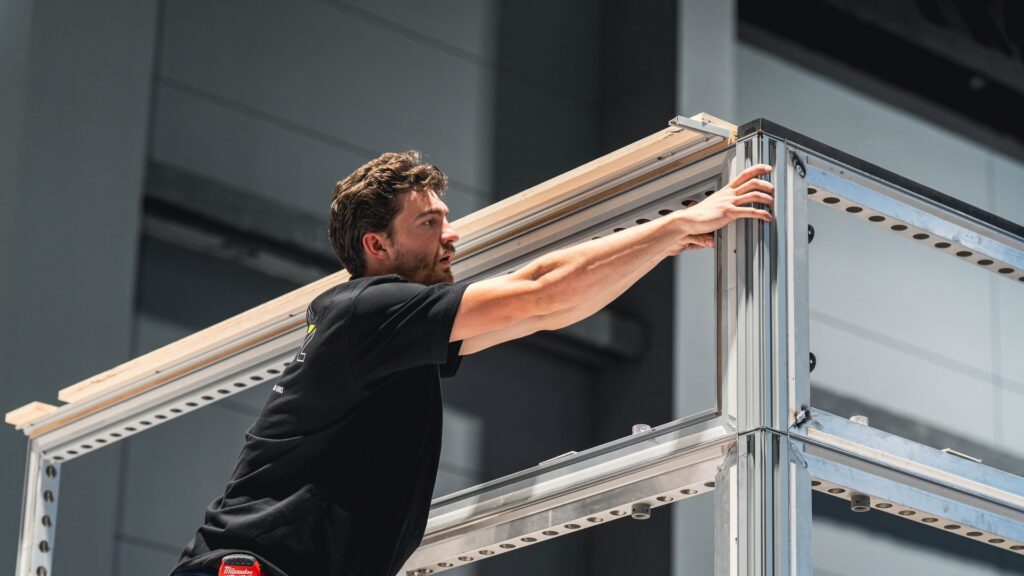
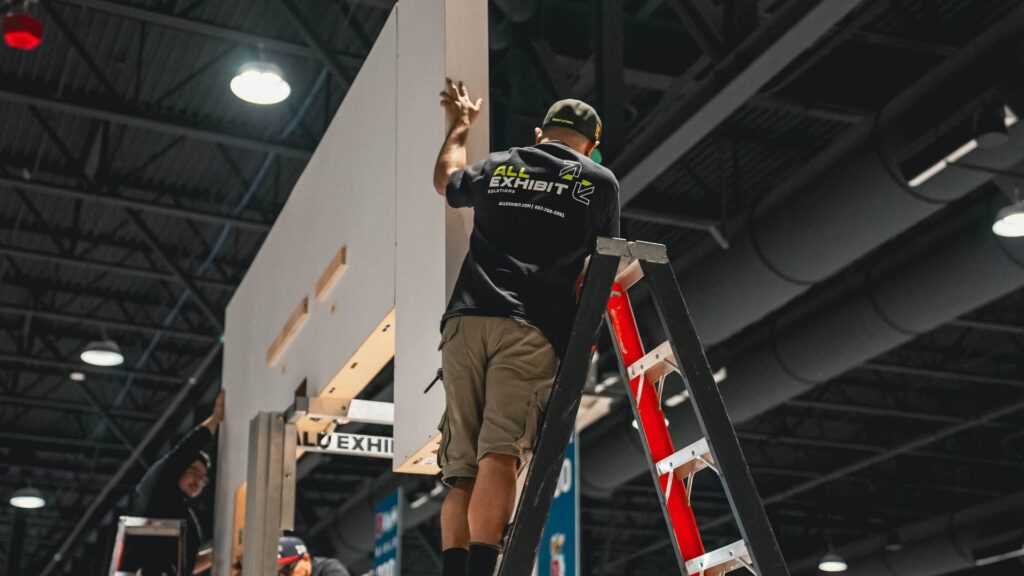
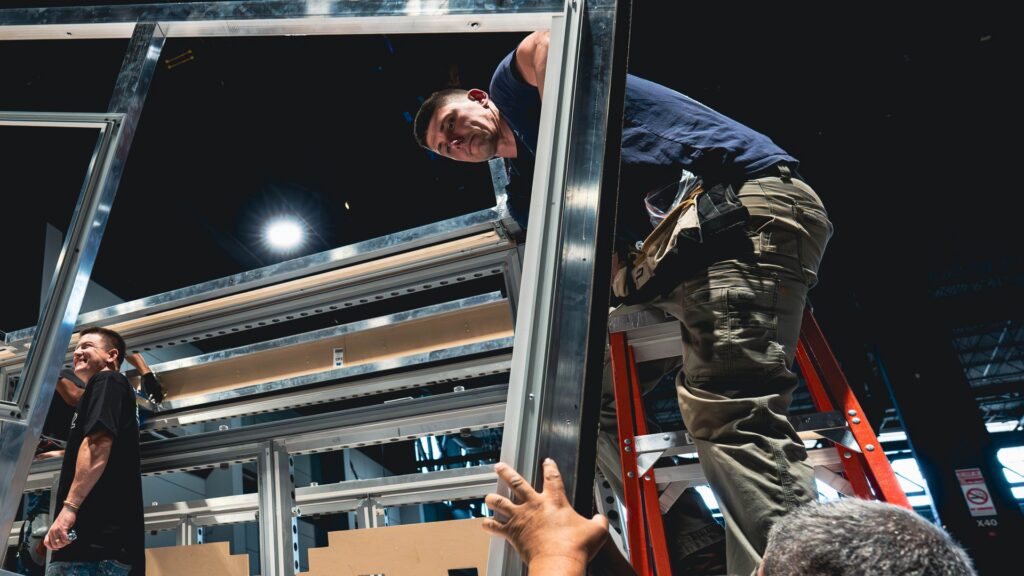
Booth design and setup are usually treated as logistics. In advertising terms they are production quality, and they directly determine whether the ad space performs.
Two figures explain why this line item deserves strategic attention rather than administrative handling:
Installation and dismantle is one of the most underestimated costs in trade show budgeting. I&D can consume a substantial share of an exhibitor’s total order, and at some venues it approaches half. Union straight-time labor at major convention centers typically runs $75 to $150 per person per hour, with overtime at 1.5x and double time on Sundays and holidays at 2x. A move-in that slips past the straight-time window, because freight arrived late or the space was not ready, can double the labor line against the estimate.
Booth presentation drives floor performance measurably. Roughly 48% of exhibitors report that eye-catching displays attract the most attendees, and layout and design improvements are associated with a 30% to 45% improvement in stop rates. Static setups are increasingly losing floor attention to LED walls, projection, and interactive displays.
Those two facts together define the job: get the exhibit installed correctly, on time, within straight-time hours, and in compliance with venue jurisdiction rules, so the advertising asset performs for the full duration of the show and the budget is not consumed by avoidable overtime.
Why Exhibitors Use an Exhibitor-Appointed Contractor
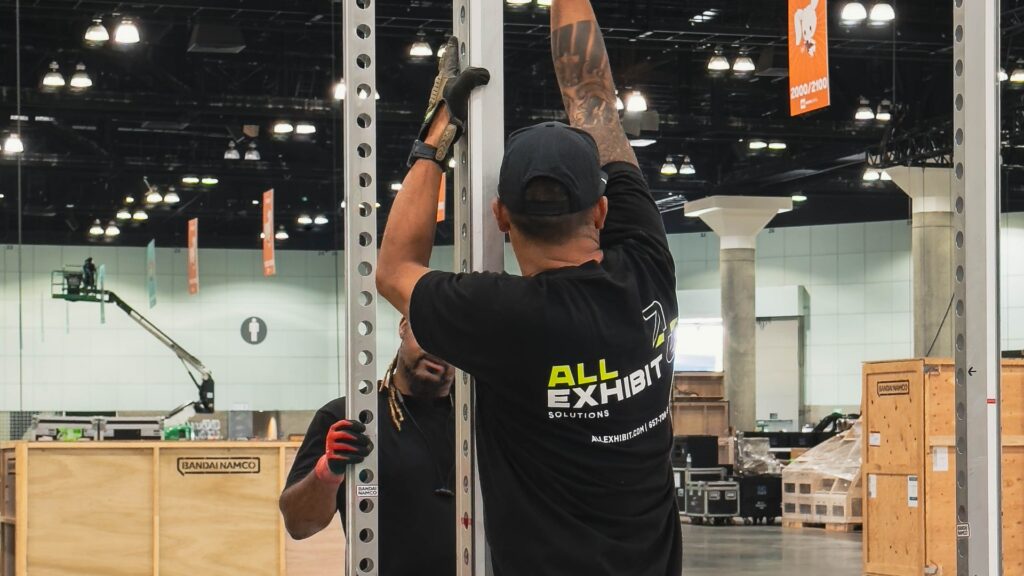
Labor jurisdiction rules differ at every convention center. Two companies can install identical booths in two cities and pay dramatically different labor costs based on local union agreements, right-to-work status, and which tasks exhibitor staff are permitted to perform. An exhibitor-appointed contractor that works the same booth across multiple shows carries institutional knowledge of that exhibit: what order the components assemble in, which crates hold what, and how long the install actually takes. That knowledge is what keeps crews inside straight time.
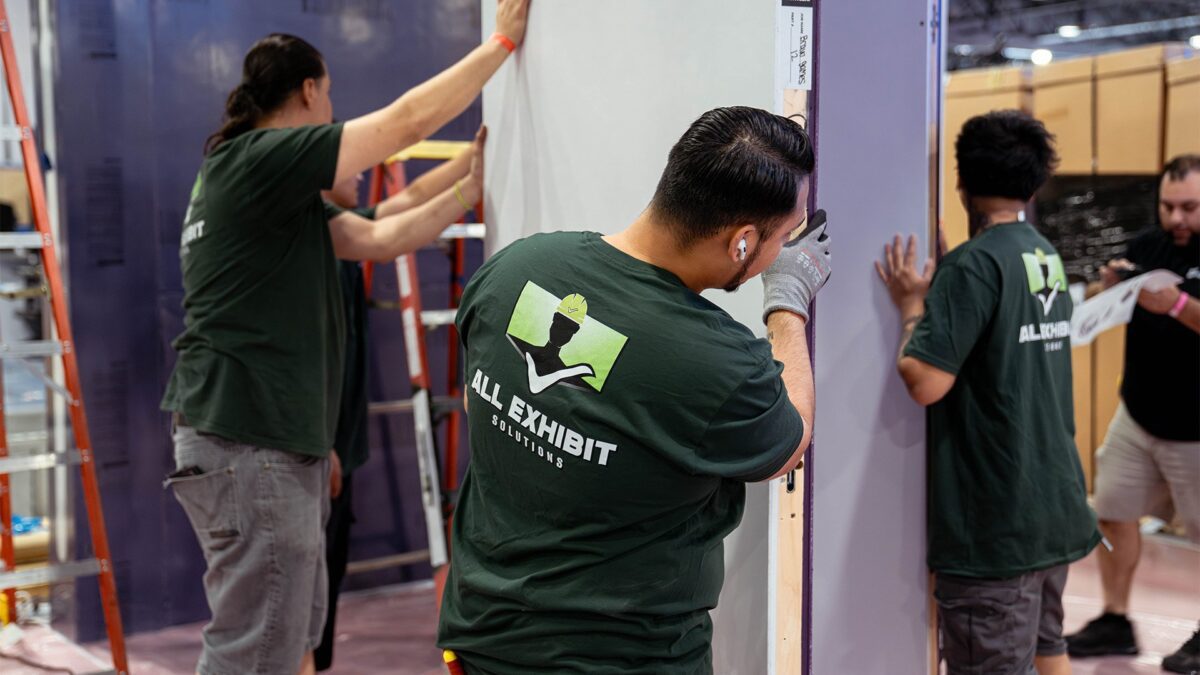
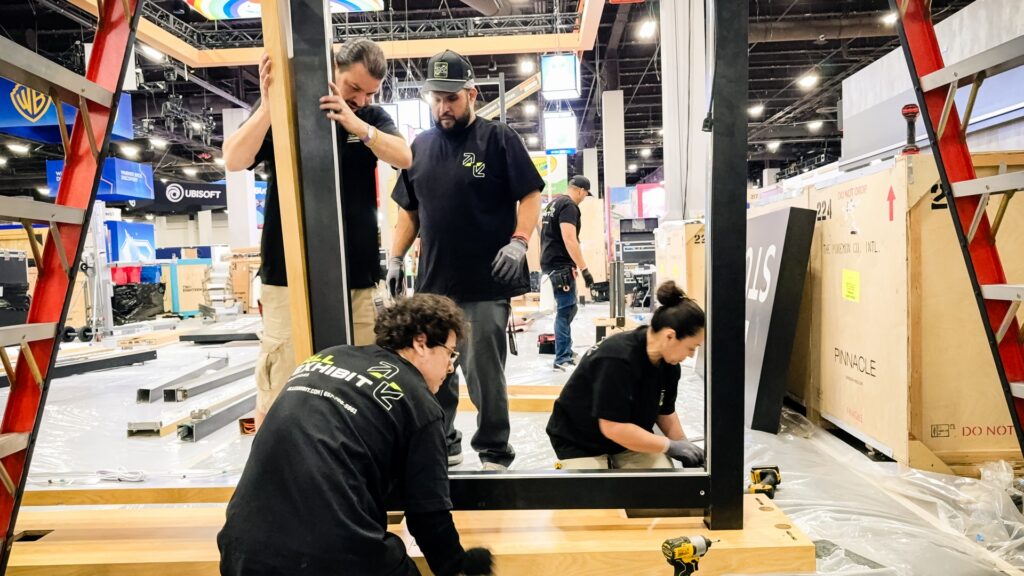
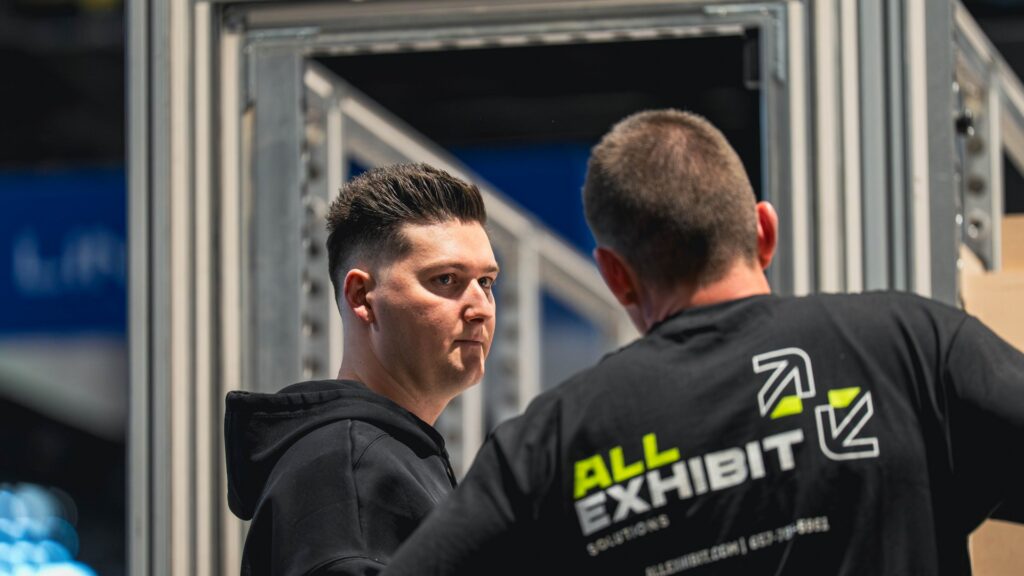
All Exhibit Solutions provides trade show installation and dismantling services including booth assembly, structural setup, graphic installation, electrical connections, and complete teardown, executed by experienced union and non-union crews under show deadlines. Across 500+ events installed in 25 states, every job runs under a dedicated on-site project supervisor.
The same crews handle corporate event installation for conferences and product launches, retail installations including pop-up shops and window displays, and experiential activations requiring complex multi-sensory buildouts. See the full range of installation and dismantling services or review service areas by state.
How to Integrate Trade Shows With the Rest of Your Advertising Program
Trade shows underperform when they operate as standalone events. The channel works as an amplifier, complementing digital advertising, content, and social media campaigns.
- Pre-show: Run targeted paid social and email to the attendee list to book booth meetings before the show opens. Booked meetings outperform walk-up traffic on close rate.
- At-show: Mirror active ad campaign messaging in booth graphics so attendees who have seen the digital creative recognize the brand on the floor.
- Post-show, immediately: Follow up within 48 hours. Roughly 40% of exhibitors wait three to five days, and about 81% use email as the follow-up channel. Speed is the single highest-leverage variable inside the exhibitor’s control.
- Ongoing: Load booth-collected contacts into retargeting audiences and nurture sequences. The show generated the audience; digital channels are what keep it warm through a long sales cycle.
Frequently Asked Questions
Is a trade show booth an advertising expense?
Generally yes. Booth space, exhibit design, graphics, and promotional materials are typically classified as advertising or marketing expenses. Travel, lodging, and staff time are usually categorized separately. Tax treatment varies by jurisdiction and entity, so verify classification with a qualified accountant.
What type of advertising is a trade show?
Experiential advertising, also called live or event advertising. It sits in the same category as pop-up activations, sponsored demonstrations, and brand experiences, distinguished from broadcast, print, digital display, and out-of-home advertising by its two-way, in-person delivery.
Are trade shows more effective than digital advertising?
They serve different functions. Digital advertising delivers reach and low-cost awareness at scale. Trade shows deliver depth, qualification, and relationship formation with a pre-qualified audience. For high-consideration B2B purchases with long sales cycles, trade shows typically produce better cost per qualified lead. For broad awareness, digital is far cheaper per impression. Most effective programs run both.
How much of a trade show budget goes to the booth itself?
The exhibit, whether designed, rented, or purchased, typically accounts for 20% to 30% of total program spend. The remainder covers booth space fees, shipping and drayage, installation and dismantle labor, travel, show services such as electrical and internet, marketing materials, and follow-up. Experienced exhibitors carry a 10% to 15% contingency line.
Do trade shows still work in 2026?
Yes, and the industry has recalibrated rather than declined. Attendance at major B2B events has recovered to or exceeded pre-pandemic levels in most verticals. The shift is toward fewer, more selective shows with higher per-show investment. The show floor is more competitive than it was, not less.
Ready to Make Your Booth Perform?
A well-built exhibit only advertises when it is standing, on time, and installed to spec. All Exhibit Solutions handles installation and dismantling so your team spends the show working leads instead of assembling hardware. Request a free quote, place an order, or see recent installations.
Recommended Articles
What Trade Show Labor Actually Costs and How to Estimate It
Then compare the estimate against the actual invoice afterward and keep the comparison. Two or three shows of that record turns estimating from guesswork into a reliable forecast. All Exhibit...

Brendan Cogbill
What Is an Exhibitor Appointed Contractor and When Do You Need One?
There is a cost dimension as well. Some shows charge an EAC processing fee, and a few apply a surcharge calculated against the value of the work being performed on the floor. These amounts are...
Brendan Cogbill
Trade Show Booth Rentals: Costs & What’s Included
It is worth asking how much of the rental inventory is genuinely reconfigurable, because that single answer shapes what you can do across a season. Many rental systems are modular by design, which...
Brendan Cogbill
Common Trade Show Rejection Reasons and How to Avoid Them
It is also worth separating the two kinds of no you might receive. A design rejection happens before the show, when your submitted plan conflicts with the rules, and it is the cheaper problem because...
Brendan Cogbill
Top Pop-Up Display Ideas for Your Exhibition Booth
Audience matters as much as venue size. A pop-up aimed at engineers and technical buyers can lean into detailed product imagery and a demo screen, while one built for a consumer-facing event might...
Brendan Cogbill
How to Choose a Trade Show Booth Company You Can Trust
However impressive a design looks in a rendering, it only matters if it goes up correctly, on time, and looking exactly as promised. Installation and dismantle is where every other decision is...
Brendan Cogbill
Inline vs. Island Booths: What Is an Inline Booth and Which Is Right for You?
The configuration you choose ripples straight through your budget and your build. Beyond the space rental itself, islands and peninsulas usually require more material, more complex structures, and...
Brendan Cogbill

Exhibit Management 101: Running Your Trade Show Program Like a Pro
A single trade show is a project. A year of trade shows is a program, and the difference between the two is exhibit management. When a company exhibits a few times a year, the work tends to be...