How to Plan a Trade Show? Lessons for Success

Brendan Cogbill
- How do you plan a trade show?
- How far in advance should you start planning?
- How much does exhibiting actually cost?
- Setting objectives you can measure
- Choosing the right show and reading competitors
- Booth design: rent or buy?
- Installation and dismantle: what to lock down
- Day-of execution
- Post-show: teardown, follow-up, measurement
- Sustainability without greenwashing
- Frequently asked questions
How Do You Plan a Trade Show?
Trade show planning works backward from the move-in date, not forward from today. Start 9 to 12 months before the show, lock the space and the budget first, then sequence exhibit design, service orders, freight, staffing, and follow-up against the show’s published deadlines. Every one of those deadlines has a price attached: order late and the same service costs 20% to 40% more.
Two numbers should anchor the whole plan. First, total show cost typically runs about three times the cost of your booth space, a rule of thumb published by EXHIBITOR Magazine and echoed across industry budget guides. Second, the costs that blow up budgets are not the exhibit, they are drayage, labor overtime, electrical, and freight, which commonly add 15% to 25% on top of what teams first estimate.
The rest of this guide covers the timeline, the budget structure, and the decisions that determine whether the show produces pipeline or just receipts. If you are still deciding whether exhibiting belongs in your marketing mix at all, start with why trade shows work as a marketing channel.
How Far in Advance Should You Start Planning a Trade Show?
Nine to twelve months for a major national show. Four to six months is workable for a regional or second-tier show if the exhibit already exists. Below three months you are paying premiums on nearly every line item and choosing from whatever floor space nobody else wanted.
Here is the countdown, built around the deadlines that actually carry financial consequences.
| When | What has to happen | Why the timing matters |
|---|---|---|
| 9 to 12 months out | Select the show, contract booth space, set goals and total budget | Corner and entrance-adjacent spaces are claimed first and carry a premium; late buyers get leftover placement |
| 6 to 9 months out | Decide rent vs. buy, commission exhibit design, submit island designs for organizer approval, book hotels | Show-adjacent hotels run 2x to 3x normal rates and sell out early; island booth designs often need rigging and height approval |
| 4 to 6 months out | Graphics production, EAC paperwork and certificate of insurance, sponsorship and show-guide ad decisions | Exhibitor-appointed contractor notification deadlines are firm; miss them and you are locked into the general contractor’s labor rates |
| 3 months out | Launch pre-show marketing, start booking booth meetings, select and brief staff | Booked meetings convert far better than walk-up traffic, and the attendee list takes time to work |
| 6 to 8 weeks out | Order from the exhibitor services kit: electrical, internet, carpet, furniture, cleaning, labor. Book freight. | This is the single highest-leverage deadline. Early-order discounts typically save 20% to 40% versus on-site rates |
| 3 to 4 weeks out | Staff training, lead capture setup and CRM integration, demo schedule, follow-up sequence written in advance | The follow-up email cannot be written after the show if you want to send it within 48 hours |
| 1 to 2 weeks out | Ship to the advance warehouse, confirm I&D crew call times, finalize collateral quantities | Advance warehouse shipping typically costs 10% to 20% less than direct-to-show delivery and is far more predictable |
| Move-in | Supervised install inside straight-time hours | Overtime runs 1.5x and Sunday or holiday double time runs 2x; a delayed install can double the labor line |
| 0 to 48 hours after | Send lead follow-up | Roughly 40% of exhibitors wait three to five days, and industry estimates suggest up to 80% of leads never get contacted at all |
| 2 to 4 weeks after | Measure against goals, debrief, arrange exhibit storage | Exhibitors who set measurable goals beforehand report 25% to 30% better outcomes; only about 37% formally measure at all |
How Much Does It Cost to Exhibit at a Trade Show?
Booth space is the number most teams budget for and the number least likely to surprise them. According to EXHIBITOR Magazine, exhibit space runs roughly $20 to $138 per square foot with a median near $59. Regional and second-tier shows often fall between $15 and $40 per square foot, while prime space at major national conventions can reach $100 to $150. Total show cost then lands at roughly three times the space fee.
A first-time small-business exhibitor at a mid-size show can put a credible presence on the floor for $4,000 to $8,000. A small-to-midsize exhibitor at a major show more typically lands between $10,000 and $30,000 all in.
| Category | Typical share of total | What it covers |
|---|---|---|
| Booth space | 20% to 30% | Square footage, badge allotment, directory listing, services portal access |
| Exhibit and graphics | 25% to 40% | Design, fabrication or rental, signage, furnishings, flooring |
| Services and logistics | 25% to 45% | I&D labor, drayage, freight, electrical, internet, AV, cleaning, storage |
| Travel and staffing | 10% to 25% | Flights, hotels, per diems, training, temporary staff |
| Marketing and lead capture | 10% to 20% | Pre-show campaigns, sponsorships, collateral, badge scanners, CRM integration |
| Contingency | 10% to 15% on top | Overtime, reprints, last-minute service orders, freight surprises |
Published allocations vary considerably between sources, so treat these as a planning framework rather than a formula. Build from your own prior-show invoices where you have them.
The Costs That Wreck Budgets
None of these are secret. They are documented in the exhibitor manual. They catch teams out because they were never in the original estimate.
- Drayage. The fee for moving your freight from the loading dock to your space and back. Charged by hundredweight, typically $100 to $200 per CWT at major shows, and up 20% to 35% since 2019 according to EXHIBITOR Magazine. A 20×20 exhibit weighing 5,000 to 8,000 pounds can incur $5,000 to $16,000 in drayage alone. It is handled exclusively by the show’s official contractor, so there is no competitive bid.
- Labor overtime. Union straight time at major convention centers runs roughly $75 to $150 per person per hour, with overtime at 1.5x and Sunday or holiday work at 2x.
- Show services. Electrical and internet commonly run $500 to $2,000. Carpet rental runs $3 to $8 per square foot. Furniture runs $200 to $1,000 and up.
- Late ordering. Ordering from the services kit after the discount deadline costs 20% to 40% more for identical service.
Setting Objectives You Can Actually Measure
“Increase brand awareness” is not an objective, because no post-show number can confirm or refute it. Objectives need a metric, a target, and a date.
Pick one primary objective per show. Programs that chase lead volume, product launch buzz, partner recruitment, and press coverage simultaneously tend to under-deliver on all four, because booth staffing, layout, and demo scheduling pull in different directions for each.
| If the objective is | Measure | Set the target before the show |
|---|---|---|
| Lead generation | Qualified leads, cost per qualified lead, leads-to-opportunity rate | Qualified lead count and acceptable cost per lead |
| Pipeline | Sourced pipeline value at 30, 60, and 90 days | Dollar pipeline target and attribution method in the CRM |
| Product launch | Demos delivered, demo-to-lead conversion, press mentions | Number of scheduled demos booked in advance |
| Existing customer retention | Booked customer meetings held, renewal conversations opened | Meeting count confirmed pre-show |
| Partner or channel recruitment | Qualified partner conversations, signed LOIs | Target account list built before travel |
Decide the attribution mechanism while you are still setting the target, not afterward. If badge scans never make it into the CRM with a campaign tag, the show has no measurable result regardless of how it felt on the floor.
Choosing the Right Show and Reading Your Competitors
The most consequential planning decision is which show, and the metric that matters is not total attendance. It is buyer density: the share of attendees who match your ideal customer profile. A regional show with 3,000 highly relevant attendees frequently outperforms a national show with 40,000 mostly irrelevant ones, at 30% to 50% of the total investment.
Ask organizers for the attendee breakdown by job title, seniority, and company size, not just the headline number. Ask what percentage of attendees are exhibitors rather than buyers, since that ratio quietly determines how many real prospects walk the floor.
What to Learn From Competitors Before You Design Anything
Pull last year’s floor plan and exhibitor list. That single document tells you which competitors committed, how much space they bought, and where they were positioned. Then look at what you can learn without guessing:
- Space commitment trend. A competitor moving from a 10×20 inline to a 30×30 island is telling you the show produces for them. One shrinking or dropping out is telling you the opposite.
- Positioning language. Their show-guide listing and booth headline reveal the claim they are leading with this year. Yours needs to be distinguishable from it at ten feet, in three seconds.
- Demo strategy. If every competitor runs scheduled stage demos, an open consultation layout stands out. If nobody demos, demoing is the differentiator.
- Adjacency. Who will be next to you matters more than most exhibitors expect. Neighboring a direct competitor invites side-by-side comparison; neighboring a complementary vendor can generate referrals.
Booth Design: Should You Rent or Buy?
Rent when you exhibit at fewer than three or four shows a year, when booth size varies between shows, or when you are testing a new market. Buy when you run a stable multi-show schedule at consistent sizes and can amortize the build across several years, accepting that ownership adds storage, refurbishment, and repair costs between shows.
Design decisions that affect performance more than aesthetics:
- Readable at distance. Attendees decide whether to approach from roughly ten feet away while walking. The single clearest thing in the booth should state what you do, not your tagline.
- Open perimeter. A table across the front of the booth reads as a barrier. Roughly 48% of exhibitors report that eye-catching displays draw the most attendees, and layout improvements are associated with 30% to 45% better stop rates.
- Freight weight. Because drayage is billed by weight, design choices are budget choices. Lighter modular systems and flat-packed components cut drayage and freight on every future show, not just this one.
- Staffing density. Plan roughly one staffer per 50 square feet of space so the booth is neither unattended nor crowded with your own team.
For more on making the footprint work, see how to maximize your trade show booth space.
Installation and Dismantle: What to Lock Down Before Move-In
Installation is where planning either holds or collapses, because it is the one phase with no slack in it. The show opens at a fixed hour whether the booth is finished or not.
Labor jurisdiction rules differ at every convention center. Two companies can install identical exhibits in two cities and pay dramatically different labor costs based on local union agreements, right-to-work status, and which tasks exhibitor staff are permitted to perform themselves. That variation is why the install plan cannot be copied from the last show.
Settle these before move-in day:
- EAC notification and insurance. If you are using an exhibitor-appointed contractor rather than the general contractor, the show has a notification deadline and a certificate-of-insurance requirement. Miss it and you lose the option.
- Straight-time targeting. Know the published straight-time window and schedule the install inside it. Overtime at 1.5x and double time at 2x is where install budgets double.
- Freight timing. Advance warehouse delivery ahead of the deadline is cheaper and more predictable than direct-to-show. Late freight is the most common cause of overtime.
- Supervision. Someone with authority over the exhibit needs to be on the floor during install to resolve problems in the moment rather than escalating them.
- Dismantle plan and storage. Decide before the show where the exhibit goes afterward. Rushed teardown is where components get damaged and where next show’s refurbishment cost is created.
A contractor that works the same exhibit across multiple shows carries knowledge no rate sheet reflects: assembly order, which crate holds what, and how long the install genuinely takes. That knowledge is what keeps a crew inside straight time.
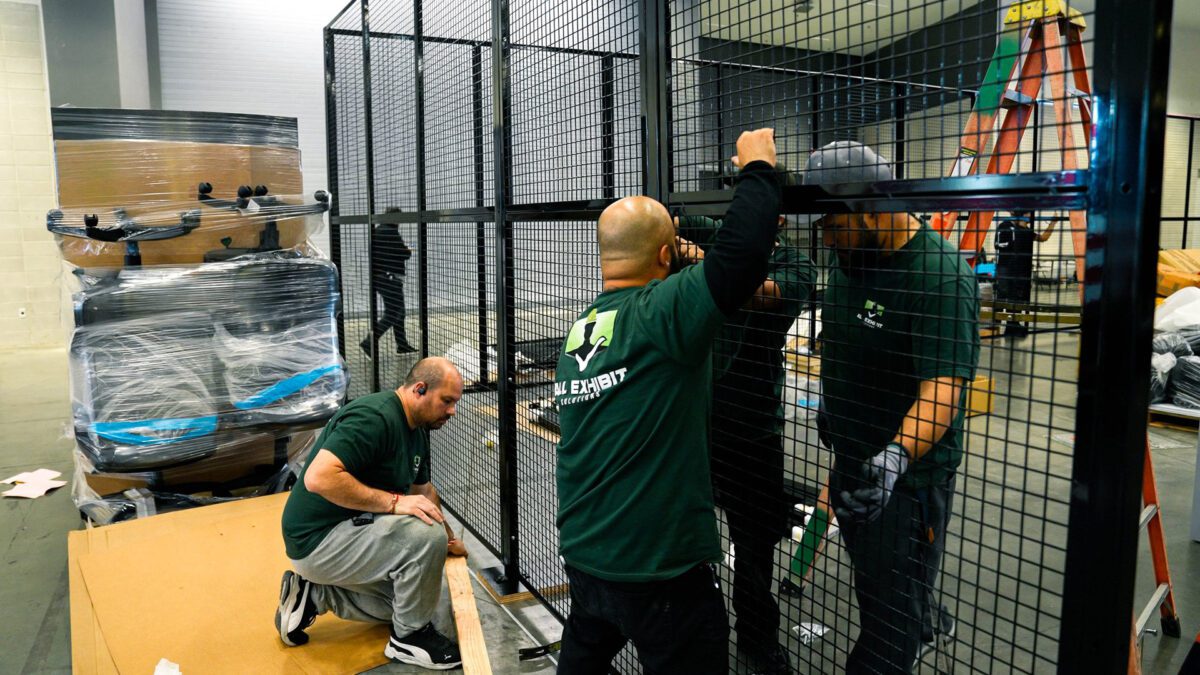
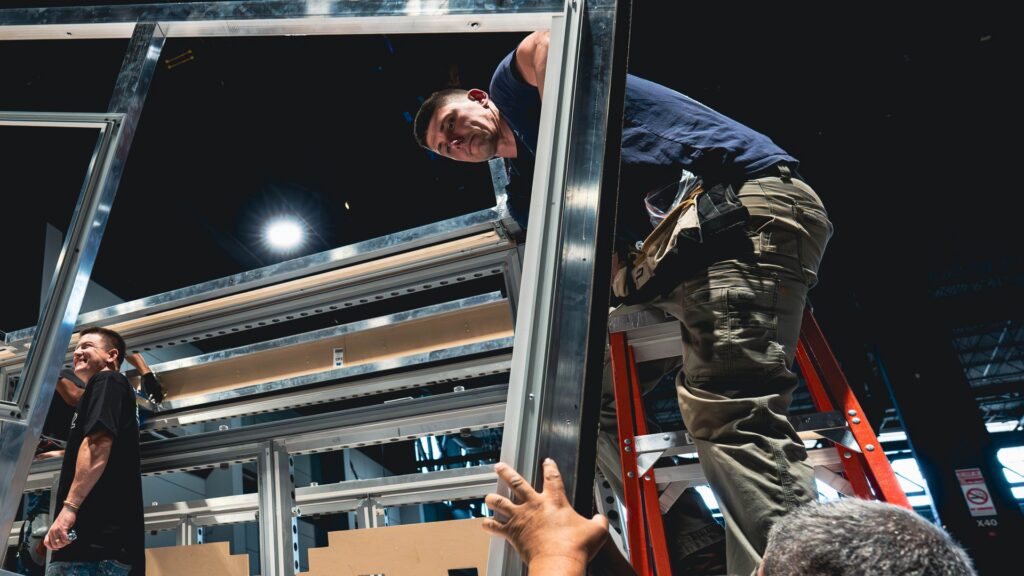
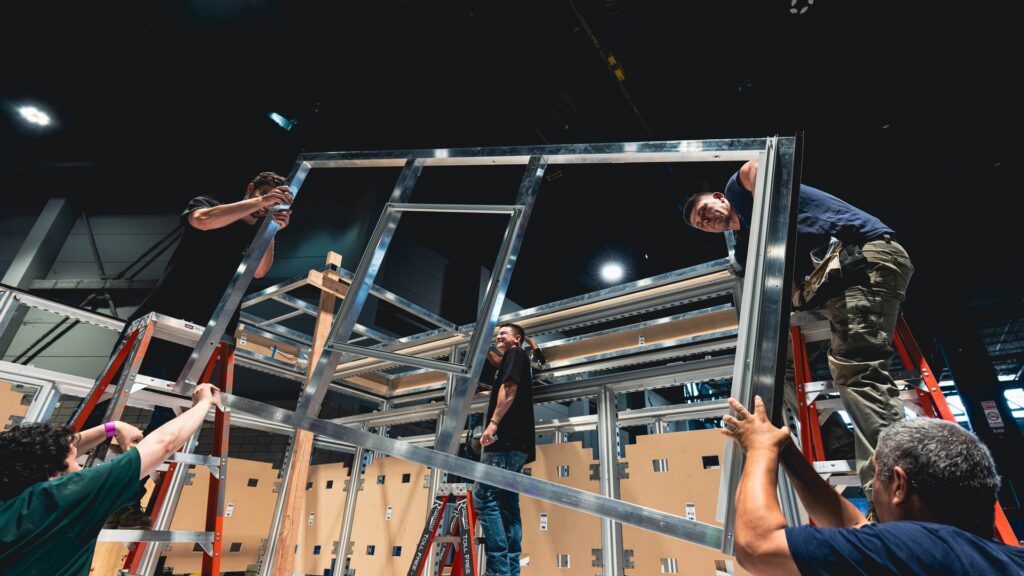
All Exhibit Solutions provides trade show installation and dismantling covering booth assembly, structural setup, graphic installation, electrical connections, freight and drayage coordination, and complete teardown, with experienced union and non-union crews and a dedicated on-site supervisor on every job. Across 500+ events installed in 25 states, that supervision is the constant.
Day-of Execution
Open the Floor With the Booth Already Finished
Arrive before doors open with the install complete, graphics straight, power tested, and lead capture logged in and confirmed working. Testing badge scanners on show morning, not during the first rush, is the difference between capturing the day’s leads and reconstructing them from business cards.
Run Demos on a Published Schedule
Scheduled demonstrations give attendees a reason to return at a specific time and give staff a natural opening line. Post times on booth signage and in social posts during the show. A demo that draws a small crowd also draws passers-by, since attendees stop where other attendees have stopped.
Qualify and Capture in the Same Conversation
Every captured lead needs three things attached before staff move on: qualification notes, next step, and owner. A scanned badge with no context is barely a lead. Brief the team to record budget, timeline, and decision authority in the moment, because nobody reliably remembers conversation 40 of a show day.
Debrief Each Evening
Fifteen minutes at the end of each day to compare which messages produced questions and which fell flat. A booth is a live test environment, and there is no reason to run day three with day one’s pitch if something better surfaced.
Post-Show: Teardown, Follow-Up, and Measurement
Follow Up Within 48 Hours
This is the highest-leverage variable in the entire program and the most commonly wasted. Roughly 40% of exhibitors wait three to five days, about 81% use email as the channel, and industry estimates suggest up to 80% of trade show leads are never contacted at all. Write the follow-up sequence three to four weeks before the show so it only needs personalizing, not drafting, while attention is still fresh.
Dismantle Deliberately
Teardown is when damage happens and when next show’s repair bill gets written. Components need to be packed to their original spec, crates need accurate contents labels, and outbound freight paperwork has to be submitted inside the show’s window or the exhibit sits in the hall accruing charges. All Exhibit Solutions handles dismantle, packing, and freight coordination, including post-event storage and asset management between shows.
Measure Against the Targets You Set
Only about 37% of exhibitors formally measure ROI after each event, while exhibitors who set measurable goals in advance report 25% to 30% better outcomes. Review at 30, 60, and 90 days rather than once: for long B2B sales cycles, the pipeline that closes in month three is invisible in a week-one report. Record total cost, qualified leads, cost per qualified lead, and sourced pipeline, then compare against the targets set during planning and against your other channels.
Sustainability Without Greenwashing
Sustainability has moved from nice-to-have to procurement requirement, as ESG teams increasingly ask marketing for trade show impact data. The problem is that a recycling logo on a booth panel is not data, and buyers have learned to tell the difference.
Events generate an average of roughly 2.5 pounds of landfill waste per attendee per day. Traditional custom booths are estimated to generate 500 to 700 kg of CO2e across production and logistics, largely because the build-use-discard cycle treats a structure used for three days as disposable.
What actually reduces impact, in rough order of effect:
- Reuse the structure. Modular aluminum framing with dye-sublimated fabric graphics can cut material waste substantially versus single-use timber and MDF builds, and aluminum is recyclable essentially indefinitely. Reuse beats recycling.
- Cut printed collateral. The largest volume of post-show waste for most exhibitors is not the booth, it is the brochures nobody took. Digital delivery to a scanned badge removes the waste and improves follow-up data at the same time.
- Reduce freight weight and distance. Lighter, flat-packed exhibits lower emissions and drayage on the same decision. This is the rare sustainability move that pays for itself immediately.
- Replace PVC vinyl. PVC banner material is generally not recyclable in municipal streams. Recycled-PET tension fabric is lighter, reprintable, and reusable across shows.
- Switch to LED. LED lighting draws substantially less power than halogen, cutting both the electrical order and the load.
If you intend to make a sustainability claim at the booth, make it countable. “This structure has been used at 14 events” or “we diverted X pounds from landfill this show year” is a claim an attendee can evaluate. “Eco-friendly materials” is not. Track program-level metrics across a show year rather than a single event: shipping weight and distance, percentage of components reused versus newly fabricated, and waste diverted from landfill.
Where All Exhibit Solutions Fits in the Plan
All Exhibit Solutions handles the installation and dismantling phase, the part of the plan with the least margin for error and the most exposure to overtime and jurisdiction rules. That means scoping against your floor plan and booth specs, coordinating freight and drayage, supervised assembly on the show floor, and packing, shipping, or storing the exhibit afterward.
The same crews cover corporate event installation for conferences and product launches, retail installations including pop-ups and window displays, and experiential activations. Review the full service range, check coverage by state, or browse recent installations.
Frequently Asked Questions
How far in advance should you plan a trade show?
Nine to twelve months for a major national show, four to six months for a regional show if the exhibit already exists. The binding constraints are booth space selection, which happens earliest and determines placement, and the exhibitor services kit discount deadline roughly six to eight weeks out, where late orders cost 20% to 40% more.
How much does it cost to exhibit at a trade show?
Plan for roughly three times your booth space cost as the total. Exhibit space itself runs about $20 to $138 per square foot depending on the show, with a median near $59. A first-time exhibitor at a mid-size show can manage $4,000 to $8,000; a small-to-midsize exhibitor at a major show typically lands between $10,000 and $30,000 all in.
What is drayage and why is it so expensive?
Drayage is the fee for moving your freight from the venue’s loading dock to your booth space and back after the show. It is billed by hundredweight, typically $100 to $200 per CWT at major shows, and it is handled exclusively by the show’s official contractor, so there is no competitive bidding. Because it is weight-based, reducing exhibit weight is the only real lever exhibitors control.
What is an exhibitor-appointed contractor?
An exhibitor-appointed contractor, or EAC, is an installation and dismantle company you hire directly rather than using the show’s general services contractor. Using one requires notifying the show by a published deadline and supplying a certificate of insurance. Exhibitors use EACs for continuity, since a contractor that knows your specific exhibit installs it faster.
How many staff do you need at a trade show booth?
A common planning ratio is one staffer per 50 square feet of booth space, so a 10×20 inline needs roughly four people and a 20×20 island roughly eight, accounting for breaks and shift coverage. Understaffing leaves visitors unattended; overstaffing creates a wall of your own team that discourages approach.
Should you rent or buy a trade show booth?
Rent below roughly three or four shows a year, when booth sizes vary, or when testing a new show. Buy when the schedule is stable and sizes are consistent enough to amortize the build across several years. Ownership adds storage, refurbishment, and repair costs that rental absorbs.
How soon should you follow up on trade show leads?
Within 48 hours. Roughly 40% of exhibitors wait three to five days, and estimates suggest up to 80% of trade show leads are never contacted at all. Writing the sequence before the show is what makes a 48-hour turnaround achievable.
How do you measure trade show ROI?
Track total show cost against qualified leads, cost per qualified lead, and sourced pipeline at 30, 60, and 90 days, with campaign tagging applied in the CRM at capture. Only about 37% of exhibitors measure formally, and those who set targets in advance report 25% to 30% better outcomes, largely because measurement is only possible against a number set beforehand.
Planning Your Next Show?
Send us your floor plan and booth specs and we will build the installation plan around your move-in window. Request a free quote or place an order.
Recommended Articles
Trade Show Booth Rentals: Costs & What’s Included
It is worth asking how much of the rental inventory is genuinely reconfigurable, because that single answer shapes what you can do across a season. Many rental systems are modular by design, which...

Brendan Cogbill
Common Trade Show Rejection Reasons (and How to Avoid Them)
It is also worth separating the two kinds of no you might receive. A design rejection happens before the show, when your submitted plan conflicts with the rules, and it is the cheaper problem because...
Brendan Cogbill
Top Pop-Up Display Ideas for Your Exhibition Booth
Audience matters as much as venue size. A pop-up aimed at engineers and technical buyers can lean into detailed product imagery and a demo screen, while one built for a consumer-facing event might...
Brendan Cogbill
How to Choose a Trade Show Booth Company You Can Trust
However impressive a design looks in a rendering, it only matters if it goes up correctly, on time, and looking exactly as promised. Installation and dismantle is where every other decision is...
Brendan Cogbill
Inline vs. Island Booths: What Is an Inline Booth and Which Is Right for You?
The configuration you choose ripples straight through your budget and your build. Beyond the space rental itself, islands and peninsulas usually require more material, more complex structures, and...
Brendan Cogbill

Exhibit Management 101: Running Your Trade Show Program Like a Pro
A single trade show is a project. A year of trade shows is a program, and the difference between the two is exhibit management. When a company exhibits a few times a year, the work tends to be...
Brendan Cogbill
What Is Suitcasing at Trade Shows, and How Do You Stop It?
The deepest protection against suitcasing is not a rule; it is a presence so strong that drifting away from it feels like missing out. A well-designed, well-built, and well-staffed booth pulls...
Brendan Cogbill
What a Strong I&D Partner Actually Saves You
On paper, installation and dismantle looks like a line item, a cost to minimize on the way to the part of the budget that feels more important. In practice, the quality of your labor partner quietly...