How to Build a Realistic Install and Dismantle Schedule

Brendan Cogbill
Introduction
Most show-floor disasters are not really failures of skill. They are failures of arithmetic. A booth that was supposed to take eight hours takes fourteen, the crew runs out of move-in window, and suddenly graphics are going up as the first visitors arrive. Almost always, the root cause traces back to a schedule that was optimistic on paper and impossible in practice. A realistic install and dismantle schedule is the single most underrated tool an exhibitor has, because it converts a stressful guessing game into a sequence everyone can actually execute.
Building one is not complicated, but it does require honesty about how long things take and discipline about the order they happen in. This is how to construct a timeline that holds up under the real conditions of a show floor, where freight runs late, drops land in the wrong spot, and the clock never stops.
Why Schedules Slip
Schedules rarely slip for one dramatic reason. They slip from a series of small, optimistic assumptions stacked on top of each other. The crew was sized for a perfect run with no surprises. The freight was assumed to arrive at the front of the window rather than the back. Tasks that actually depend on each other were imagined happening in parallel. Each assumption seems harmless alone, but together they quietly guarantee an overrun. The fix is not to work faster on site; it is to plan more honestly before anyone shows up.
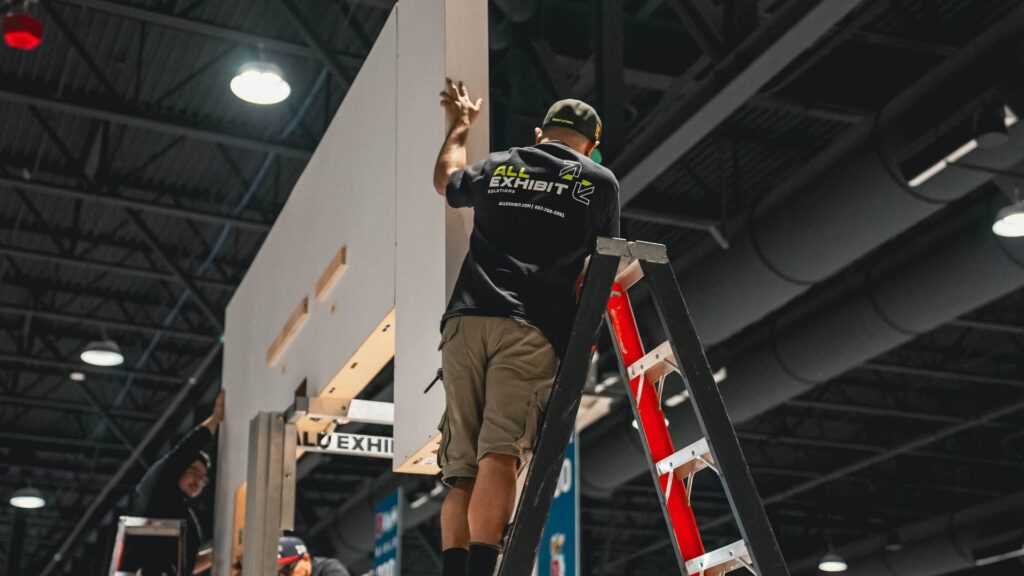
It helps to remember that install and dismantle is a real trade with a real sequence, not a generic “setup.” Our overview of how trade show installation and dismantle work lays out that sequence in detail, and a schedule is simply that sequence mapped against the clock.
Start From the Show’s Fixed Dates
Every schedule is anchored by dates you do not control, so start there. Pull the exact move-in window, target freight and carrier deadlines, and the move-out window from the exhibitor manual. Note when the hall opens to exhibitors, when aisle carpet goes down, and when forklift and rigging services are available, because those gate when your work can actually begin. Working backward and forward from these fixed points keeps the plan tethered to reality instead of to wishful timing.
Pay special attention to the gap between when you can get into the space and when the show opens. That window, not your ideal build time, is the real constraint. If the booth needs sixteen hours of work and the hall gives you twelve, you have a problem to solve now, at a desk, rather than at midnight on the floor.
Estimate Labor Hours Honestly
The heart of a good schedule is an honest labor estimate. Break the build into its real tasks: unpacking and staging, structure assembly, electrical, graphics and soft goods, AV setup and testing, and final detailing. Assign realistic hours to each based on the booth’s actual complexity, not a best case. Then translate total hours into crew size and clock time, remembering that doubling the crew does not always halve the time, because some tasks can only be done by so many hands at once.
Complexity is the multiplier people underestimate most. Rigging, custom millwork, large-format graphics, and integrated technology all take longer than they look and tolerate fewer shortcuts. The same factors that drive cost also drive time, which is why our look at exhibition stand cost and pricing factors is a useful gut check when you are estimating how many hours a build truly needs.
Sequence the Work to Avoid Bottlenecks
A list of tasks is not a schedule until it is ordered by dependency. Structure has to be set and stable before graphics can hang. Electrical generally needs to be in before certain elements are closed up. AV cannot be tested until power is live. Mapping these dependencies prevents the most common form of wasted time, which is a crew standing idle because the thing they need next is not ready yet. Good sequencing keeps every pair of hands productive from the first hour to the last.
Sequencing also tells you when to bring people in. There is no value in a full crew arriving before the freight does, and there is real cost in a specialist standing around waiting for the structure to be ready. A schedule that stages arrivals to match the work saves money and keeps the floor calm.
Build In Buffer for the Unexpected
A schedule with no slack is a schedule that fails the first time anything goes wrong, and on a show floor something usually does. Freight arrives late, a drop is in the wrong place, a panel is damaged in transit, a screen refuses to power on. Build a realistic buffer into the plan so these normal hiccups do not cascade into a missed opening. A common rule of thumb is to add meaningful contingency time rather than assuming a flawless run, because the flawless run is the exception, not the baseline.
The goal of buffer is not laziness; it is resilience. A booth that is finished and tested the evening before doors open, with time to spare, lets your team rest and start the show sharp. A booth that comes together in the final frantic minutes starts the show already behind.
Plan the Dismantle Side With Equal Care
Teardown gets half the planning and causes half the problems, which is no coincidence. The dismantle has its own hard deadlines, including when empties are returned, when the carrier must be checked in, and when the hall must be cleared. Schedule the teardown as deliberately as the install: who breaks down what, in what order, and by when, all timed against the move-out window. A rushed, unplanned teardown is where booths get damaged and freight gets stranded.
Treat install and dismantle as two ends of one continuous plan rather than separate events. The way the booth was packed and documented going in directly determines how fast and safely it comes apart, so a strong schedule accounts for both halves from the start. When All Exhibit Solutions plans a project, the move-out is mapped on the same timeline as the move-in, so the crew is never improvising the exit.
Put the Schedule in One Shared Document
A schedule that lives in one person’s head is not a schedule; it is a risk. Capture the whole plan in a single shared document with clear milestones, owners, and times, and make sure everyone from your team to your labor partner is working from the same version. When the inevitable adjustment happens on site, a shared schedule lets everyone reorient quickly instead of trading guesses. The clarity itself becomes a kind of buffer.
Share the schedule before anyone travels, not when the crew is standing on the dock. A short briefing that walks the team through the sequence, the milestones, and each person’s role turns a document into a shared understanding, and it surfaces objections while there is still time to act on them. The crew lead who notices that the AV test is scheduled before power is live can flag it in a five-minute call rather than discover it as a dead end on the floor. The best schedules are pressure-tested by the people who will execute them, because they are the ones who know where the plan meets reality.
This is also where an experienced partner earns their place. A seasoned crew has built hundreds of these timelines and knows where real-world delays hide, so the estimate is grounded in experience rather than hope. If you want help turning your booth and your show’s deadlines into a plan that actually holds, the All Exhibit Solutions installation and dismantle team does exactly that. Tell us your show and your booth, and let’s build your timeline together well before move-in day.
Recommended Articles
What Trade Show Labor Actually Costs and How to Estimate It
Then compare the estimate against the actual invoice afterward and keep the comparison. Two or three shows of that record turns estimating from guesswork into a reliable forecast. All Exhibit...

Brendan Cogbill
What Is an Exhibitor Appointed Contractor and When Do You Need One?
There is a cost dimension as well. Some shows charge an EAC processing fee, and a few apply a surcharge calculated against the value of the work being performed on the floor. These amounts are...
Brendan Cogbill
Trade Show Booth Rentals: Costs & What’s Included
It is worth asking how much of the rental inventory is genuinely reconfigurable, because that single answer shapes what you can do across a season. Many rental systems are modular by design, which...
Brendan Cogbill
Common Trade Show Rejection Reasons and How to Avoid Them
It is also worth separating the two kinds of no you might receive. A design rejection happens before the show, when your submitted plan conflicts with the rules, and it is the cheaper problem because...
Brendan Cogbill
Top Pop-Up Display Ideas for Your Exhibition Booth
Audience matters as much as venue size. A pop-up aimed at engineers and technical buyers can lean into detailed product imagery and a demo screen, while one built for a consumer-facing event might...
Brendan Cogbill

How to Choose a Trade Show Booth Company You Can Trust
However impressive a design looks in a rendering, it only matters if it goes up correctly, on time, and looking exactly as promised. Installation and dismantle is where every other decision is...
Brendan Cogbill
Inline vs. Island Booths: What Is an Inline Booth and Which Is Right for You?
The configuration you choose ripples straight through your budget and your build. Beyond the space rental itself, islands and peninsulas usually require more material, more complex structures, and...
Brendan Cogbill

Exhibit Management 101: Running Your Trade Show Program Like a Pro
A single trade show is a project. A year of trade shows is a program, and the difference between the two is exhibit management. When a company exhibits a few times a year, the work tends to be...