Trade Show Storage vs. On-Site Teardown: Which Is Right for Your Booth?

Brendan Cogbill
Introduction
When the last visitor drifts away and the hall lights come up, every exhibitor faces a quiet but consequential decision: what happens to the booth now? Two paths open up. You can have the structure dismantled and placed into trade show storage, ready to reappear at the next event, or you can tear it down on site and ship it back, repurpose it, or retire it after a single use. It sounds like a logistics footnote, but the choice quietly shapes your costs, your timelines, and how much hassle every future show carries with it.
Neither approach is universally right. The smart move is to match the decision to how often you exhibit, how custom your booth is, and how much you value convenience over control. Here is how the two compare, and how to tell which one fits the way your program actually runs.
What Trade Show Storage Actually Involves
Trade show storage means warehousing your booth between events so the same structure can travel out again and again. It is more than parking a few crates in a corner. A real storage program tracks every component, inspects the booth for wear after each show, handles minor refurbishment, and stages everything for the next outbound shipment. Done well, it turns an expensive one-time build into a reusable asset that shows up looking sharp season after season.
That convenience comes with responsibilities. Someone has to manage the inventory, keep the space organized, and make sure crates are loaded in the right order for the next event. When those details are handled by people who know the booth, storage becomes nearly invisible to you. For a closer look at the practical side, our guide on storing your trade show booth walks through what a well-run program includes.
The Case for On-Site Teardown
On-site teardown is the other side of the coin. As soon as the show closes, the booth comes down at the venue and either ships back to your own facility, returns to a rental provider, or is retired entirely. For exhibitors who rent their booths, use lightweight or disposable elements, or simply prefer not to manage a warehouse, this approach keeps things clean. There is no recurring storage fee, no inventory to track, and nothing sitting idle between shows.
The trade-off is that you start closer to square one each time. If the booth ships back to your office, you take on the handling and the space yourself. If it is a rental, you pay rental rates again at the next event. On-site teardown trades the ongoing commitment of storage for a higher cost or more effort at each individual show.
Comparing the Real Costs
The cost comparison rarely comes down to a single number. Storage carries a recurring fee, but it spreads the price of a custom build across many shows and protects an asset you already paid for. On-site teardown avoids that recurring fee, yet it can quietly cost more over time through repeated rentals, repeated freight to and from your own facility, or the gradual wear of booths that are handled and rehandled without professional care.
The deciding factor is almost always frequency. A brand that exhibits a dozen times a year will usually find that storing a reusable booth costs far less than renting or rebuilding for each event. A company that shows up to two or three events annually may find the opposite, where paying to store a booth for ten idle months makes little sense. Run the numbers across a full year rather than a single show, and the right answer tends to reveal itself.
Logistics, Timing, and Risk
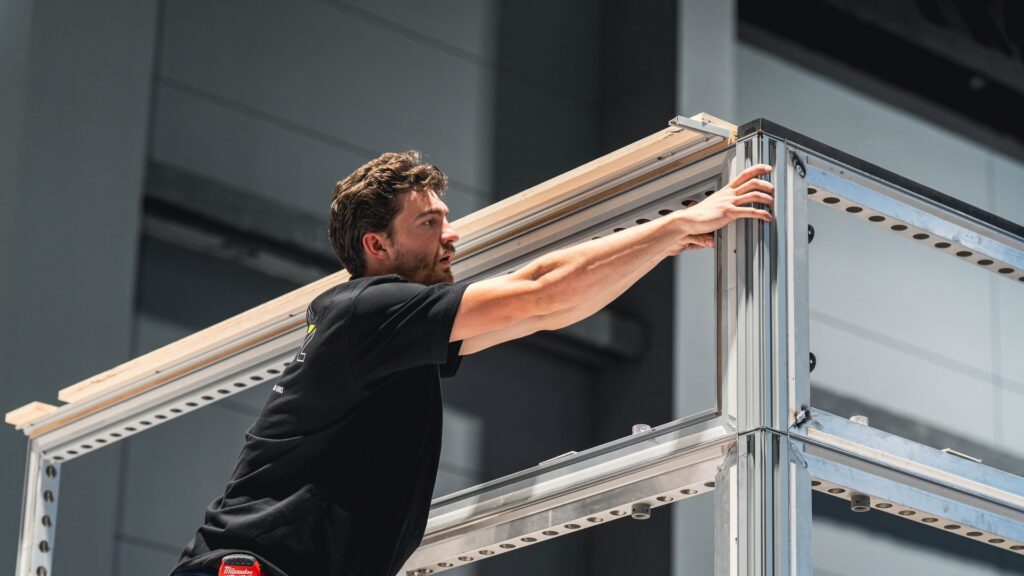
Move-out windows are notoriously tight. The moment a show ends, every exhibitor in the hall is racing to clear the floor, and a rushed teardown is where booths get damaged. A structure broken down carelessly to beat the clock can arrive at storage with bent frames or scratched panels, quietly eroding the value you were trying to protect. This is true whether you store the booth or ship it home, which is why the quality of the dismantle matters as much as the destination.
Understanding the mechanics helps you plan realistically. Our overview of how installation and dismantle work lays out the move-out sequence and the deadlines that govern it, so you can build a teardown plan that protects the booth instead of gambling with it.
How to Decide What Fits Your Program
Start with your calendar. If you exhibit frequently and own a custom booth built to last, storage is usually the economical and practical choice, because it keeps a valuable asset ready and spreads its cost across many appearances. If you exhibit occasionally, rent your booth, or value the simplicity of walking away clean after each show, on-site teardown tends to make more sense.
Beyond frequency, weigh how custom and how durable your booth is. A bespoke structure with significant value rewards careful storage and reuse, while a modest or modular setup may be cheap enough to teardown and refresh as needed. Your own appetite for managing logistics matters too. Some teams happily coordinate inventory and freight; others would rather hand the entire end-of-show process to someone else and never think about a crate again.
When a Hybrid Approach Wins
Plenty of exhibitors do not choose one path for everything. A common and sensible pattern is to store the custom island that anchors your flagship events while tearing down and returning the rental kits used at smaller regional shows. That way you protect and reuse the booth that justifies the investment, and you avoid paying to store hardware that is cheaper to rent fresh each time.
A hybrid model also lets your strategy evolve. As your show schedule grows or contracts, you can shift more of your inventory toward storage or toward teardown without overhauling everything at once. The point is to treat the decision as flexible rather than permanent, revisiting it as your calendar and your booth inventory change.
Questions That Sharpen the Decision
If the choice still feels close, a few pointed questions usually break the tie. How many shows will this booth work in the next twelve months, and is that number climbing or holding steady? How much did the structure cost to build, and what would it cost to replace if it were damaged or scrapped? And how much warehouse space, staff time, and freight budget can you realistically commit to managing an owned booth between events? The answers turn a vague preference into a clear direction.
Honest answers tend to point firmly one way. A high show count paired with a valuable, hard-to-replace booth leans heavily toward storage, where reuse protects the investment and keeps each event affordable. A light schedule, a modest or rented structure, and little appetite for logistics lean toward teardown. The goal is not to find a universally correct answer but the one that fits how your team actually operates this year, with this booth and this calendar.
Making the End of the Show as Smooth as the Start
Whatever you decide, the quality of the labor at move-out determines whether your booth survives to perform another day. A skilled crew breaks the structure down in the right order, protects fragile components, and either preps it for storage or readies it for the trip home, all within the window the show allows. All Exhibit Solutions provides nationwide installation and dismantle labor and can manage the handoff to storage or freight, so the end of one show sets up a clean start at the next.
That continuity is the real prize. When the same team that took your booth down knows exactly how it goes back up, every future show begins a step ahead instead of a step behind.
Still weighing whether to store your booth or tear it down after each show? Let’s match the plan to your calendar. Tell us how often you exhibit and what your booth is made of, and the team at All Exhibit Solutions will help you choose the approach that saves you the most time, money, and worry.
Recommended Articles
What Trade Show Labor Actually Costs and How to Estimate It
Then compare the estimate against the actual invoice afterward and keep the comparison. Two or three shows of that record turns estimating from guesswork into a reliable forecast. All Exhibit...

Brendan Cogbill
What Is an Exhibitor Appointed Contractor and When Do You Need One?
There is a cost dimension as well. Some shows charge an EAC processing fee, and a few apply a surcharge calculated against the value of the work being performed on the floor. These amounts are...
Brendan Cogbill
Trade Show Booth Rentals: Costs & What’s Included
It is worth asking how much of the rental inventory is genuinely reconfigurable, because that single answer shapes what you can do across a season. Many rental systems are modular by design, which...
Brendan Cogbill
Common Trade Show Rejection Reasons and How to Avoid Them
It is also worth separating the two kinds of no you might receive. A design rejection happens before the show, when your submitted plan conflicts with the rules, and it is the cheaper problem because...
Brendan Cogbill
Top Pop-Up Display Ideas for Your Exhibition Booth
Audience matters as much as venue size. A pop-up aimed at engineers and technical buyers can lean into detailed product imagery and a demo screen, while one built for a consumer-facing event might...
Brendan Cogbill
How to Choose a Trade Show Booth Company You Can Trust
However impressive a design looks in a rendering, it only matters if it goes up correctly, on time, and looking exactly as promised. Installation and dismantle is where every other decision is...
Brendan Cogbill
Inline vs. Island Booths: What Is an Inline Booth and Which Is Right for You?
The configuration you choose ripples straight through your budget and your build. Beyond the space rental itself, islands and peninsulas usually require more material, more complex structures, and...
Brendan Cogbill

Exhibit Management 101: Running Your Trade Show Program Like a Pro
A single trade show is a project. A year of trade shows is a program, and the difference between the two is exhibit management. When a company exhibits a few times a year, the work tends to be...