Refurbish or Replace? Getting More Life From Your Trade Show Exhibit

Brendan Cogbill
Introduction
Somewhere around year three or four, most exhibit owners have the same quiet conversation. The booth still works, but it does not look the way it did. The graphics reference a tagline you no longer use, a panel took damage last season, and the whole thing feels a half-step behind the brand it is supposed to represent.
The instinct is often to start over. Sometimes that is right. Frequently it is not, and a targeted refresh delivers most of the visual impact for a fraction of the cost. Knowing how to tell the difference is worth real money, and it comes down to a handful of honest questions about the structure underneath.
Separate the Structure From the Skin
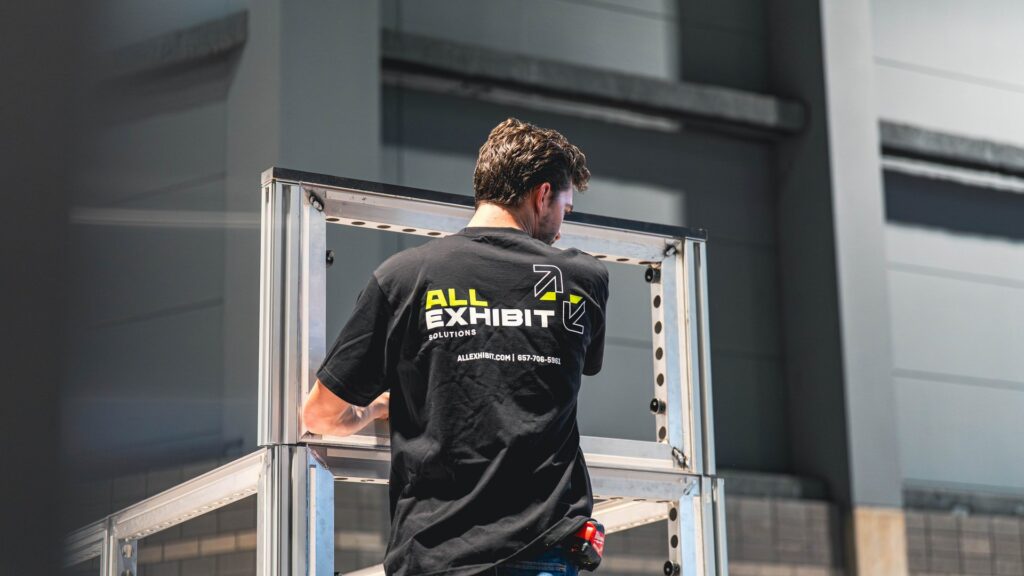
The most useful distinction is between the bones of an exhibit and everything you actually see. Aluminum extrusion frames, connectors, and well-built substructures are durable and often have years of life left even when the booth looks dated. Graphics, fabric, laminate surfaces, lighting, and flooring are the elements that age visibly.
When a booth feels tired, it is usually the skin rather than the bones. That is good news, because replacing the visible layer is dramatically cheaper than rebuilding the structure. Ask what is actually worn before assuming the whole exhibit needs to go.
What a Refresh Usually Involves
The most common refresh is a graphics replacement, which changes the booth’s entire appearance for a fraction of a rebuild. New fabric or panel graphics over an existing frame can make a five-year-old structure look current.
Beyond graphics, typical work includes replacing damaged panels, refinishing or re-laminating counters, upgrading lighting to current LED fixtures, replacing worn flooring, and updating the technology mounted in the booth. Each of these can be done individually, which means a refresh can be staged across budget cycles rather than absorbed all at once.
Keeping the original drawings and a parts inventory makes this distinction far easier to assess. Exhibitors who can produce the build documentation, a component list, and a record of what has already been replaced get accurate refurbishment quotes quickly. Those working from memory usually pay for an assessment first, simply to establish what they own.
Signs a Refresh Will Do
Refurbishment is usually the right call when the structure is sound and assembles correctly, when the layout still serves how you actually use the booth, when the damage is cosmetic and localized, and when your brand has evolved in presentation rather than fundamentally changed.
If your honest complaint is that the booth looks dated rather than that it does not work, you are almost certainly describing a graphics and finishes problem. That is a refresh, and it is the cheapest significant improvement available to an exhibitor.
A refresh is also the natural moment to fix the small annoyances the crew has been absorbing for years. The panel that never quite lines up, the counter door that sticks, the cable run that has to be improvised at every show: these are cheap to address while the exhibit is already apart and being worked on, and they quietly shorten every future install.
Signs It Is Time to Replace
Replacement starts to make sense when the structure itself is compromised, when assembly has become unreliable or requires workarounds the crew has learned to live with, or when components are no longer manufactured and cannot be sourced.
It is also the answer when your needs have genuinely changed. A booth designed for a ten-by-twenty space cannot become an island, and an exhibit built around a product line you no longer sell is not a finishes problem. When the layout itself is wrong, refreshing the surfaces only makes an unsuitable booth look newer. Our walkthrough of the exhibit fabrication process covers what a ground-up build actually involves.
There is a timing argument as well. A refresh can usually be turned around in weeks where a new build runs months, which matters when a rebrand lands or an unexpected show appears on the calendar. If the deadline is short, refurbishment is often not just the cheaper option but the only realistic one.
How the Math Usually Works
A graphics-only refresh typically costs a small fraction of a new exhibit. A broader refurbishment involving panels, counters, lighting, and flooring lands somewhere in the middle. A new custom build sits at the top, alongside the design and engineering time that comes with it.
The useful comparison is cost per show across the remaining life. A refresh that costs a modest amount and buys three more seasons usually wins decisively against a rebuild, unless the structure genuinely cannot deliver those seasons. Our breakdown of exhibition stand cost factors is a helpful reference when comparing quotes for either path.
Accumulated repair spending is a useful signal too. If you are patching something before every show, the structure is telling you where it stands. Adding up two or three seasons of running repairs often reveals you have already spent a meaningful share of a new exhibit without ever getting a new exhibit, which is the point where replacement stops being the expensive option.
Storage Is Usually the Real Culprit
When exhibits age badly, storage is frequently the reason rather than use. A booth kept in proper cases in a climate-controlled space stays serviceable for years. One stacked in a warehouse corner, or packed damp after a show, deteriorates quickly regardless of how well it was built.
This is the least glamorous and most consequential factor in how long an exhibit lasts, and it is entirely controllable. Our guide to trade show booth storage covers what good storage actually looks like and why it determines whether refurbishment is even an option later.
A hybrid path is often the smartest answer for larger programs. Keep the structural investment, replace the visible layer entirely, and add one genuinely new focal element such as a rebuilt demo station or an updated tower. Visitors read the booth as new, while the budget reflects a refresh, and the components you already own keep earning.
Getting an Honest Assessment
Before committing either way, have the exhibit inspected by someone who handles booths for a living. A proper assessment means setting it up, checking the frame and connectors, identifying what is damaged versus merely worn, and confirming whether replacement parts are still available.
Be mindful of who you ask. A firm that only builds new exhibits has an obvious interest in the answer. Someone who installs and dismantles booths week in and week out sees the structure’s real condition, and has no particular stake in whether you refresh or rebuild.
Refurbishing also holds its value when the exhibit’s next chapter is resale or trade-in. A well-maintained modular system with current graphics and documented history is worth something to another exhibitor; a neglected one is worth scrap. Even if replacement is eventually the answer, arriving there with an asset in good condition softens the cost of whatever comes next.
Planning the Work Between Shows
Refurbishment happens in the gaps in your calendar, so it needs the same scheduling discipline as a show. Graphics have production lead times, panels take time to fabricate, and the exhibit has to be available rather than sitting in transit to the next event.
Teams that run this well plan refreshes as part of their annual program rather than reacting when the booth finally looks too tired to use, which is the approach we describe in exhibit management. All Exhibit Solutions sees exhibits at their most revealing moment, fully assembled and then taken apart again, which is exactly when condition is obvious. You can read more about the All Exhibit Solutions team and our installation and dismantle services, part of the full range of services we offer, and if you are unsure whether your booth has another season in it, reach out and we will give you a straight assessment before you spend on a rebuild.
Recommended Articles
How to Build a More Sustainable Trade Show Exhibit
Be careful about claiming more than you do, though. Audiences and event organizers have become sharper about recognizing a green claim with nothing behind it, and overstating is worse than saying...

Brendan Cogbill
What Trade Show Labor Actually Costs and How to Estimate It
Then compare the estimate against the actual invoice afterward and keep the comparison. Two or three shows of that record turns estimating from guesswork into a reliable forecast. All Exhibit...
Brendan Cogbill
What Is an Exhibitor Appointed Contractor and When Do You Need One?
There is a cost dimension as well. Some shows charge an EAC processing fee, and a few apply a surcharge calculated against the value of the work being performed on the floor. These amounts are...
Brendan Cogbill
Trade Show Booth Rentals: Costs & What’s Included
It is worth asking how much of the rental inventory is genuinely reconfigurable, because that single answer shapes what you can do across a season. Many rental systems are modular by design, which...
Brendan Cogbill
Common Trade Show Rejection Reasons and How to Avoid Them
It is also worth separating the two kinds of no you might receive. A design rejection happens before the show, when your submitted plan conflicts with the rules, and it is the cheaper problem because...
Brendan Cogbill
Top Pop-Up Display Ideas for Your Exhibition Booth
Audience matters as much as venue size. A pop-up aimed at engineers and technical buyers can lean into detailed product imagery and a demo screen, while one built for a consumer-facing event might...
Brendan Cogbill
How to Choose a Trade Show Booth Company You Can Trust
However impressive a design looks in a rendering, it only matters if it goes up correctly, on time, and looking exactly as promised. Installation and dismantle is where every other decision is...
Brendan Cogbill
Inline vs. Island Booths: What Is an Inline Booth and Which Is Right for You?
The configuration you choose ripples straight through your budget and your build. Beyond the space rental itself, islands and peninsulas usually require more material, more complex structures, and...